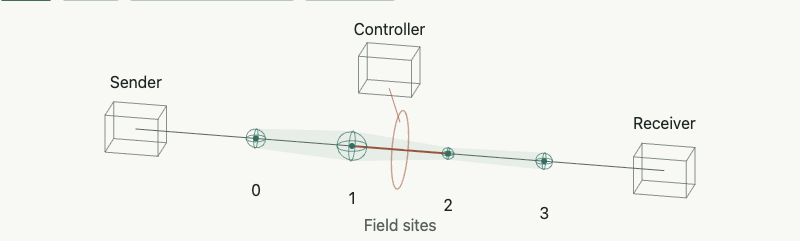
 Four sites · finite-model result
77.37% average fidelity
At model time 22.5, one calibrated receiver phase correction raised the best sampled fidelity from 67.29% to 77.37%. The always-open control did better.
Most calculations tell a shutter when to open. Here the switch is a quantum system that can remember the wave it lets through. The whole chain obeys one fixed law of motion. Could an observer at the far end tell who opened the gate?
Right-side share of the excess packet occupation at model time 24
Field, clock and interaction exchange energy. The largest drift in their total is 3.98 × 10⁻¹³ in model units. Equations 26–30
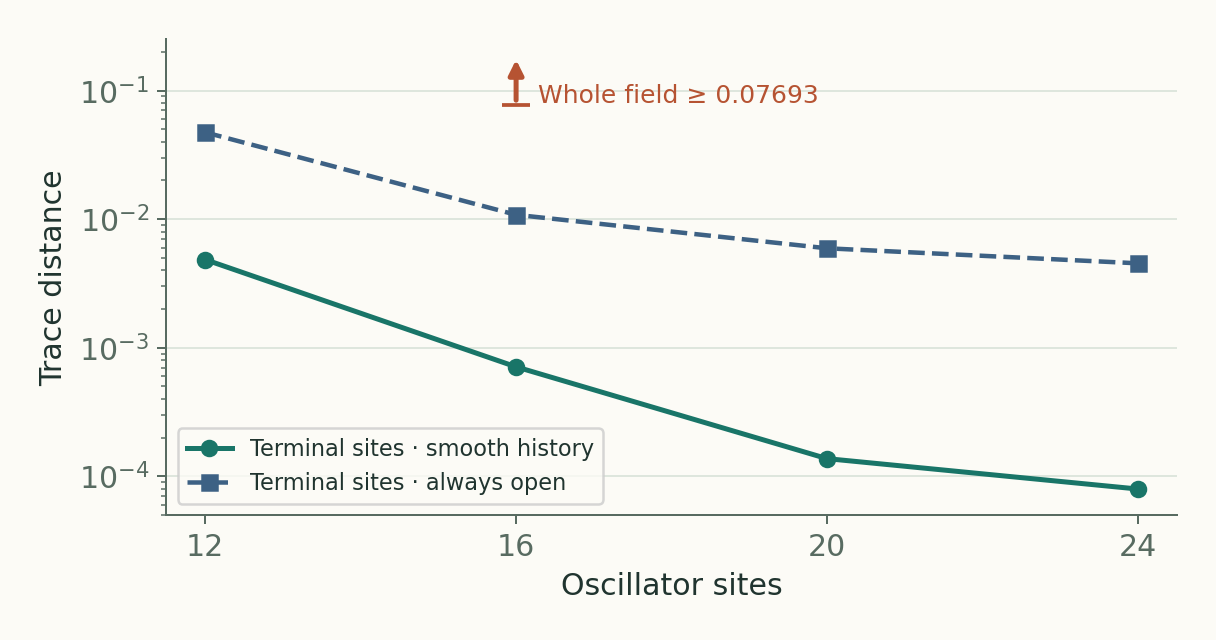
Give a second chain an externally prescribed opening, timed from the free controller before looking at the output. An observer with access to the last three sites sees nearly the same state in both chains. The whole field still carries evidence of which shutter acted.
Suppose someone chooses the shutter by a fair coin toss and gives you one output. From the last three sites, even the best possible guess is right only about 50.04% of the time. With the entire field available, the success probability is at least 53.84%. A scheduled switch can therefore predict the view at one port while missing evidence elsewhere.
A field packet approaches the central link. The saved run tracks the field at each site and the response of the controller. The vacuum run gives a comparison with no incoming packet.
Open field simulation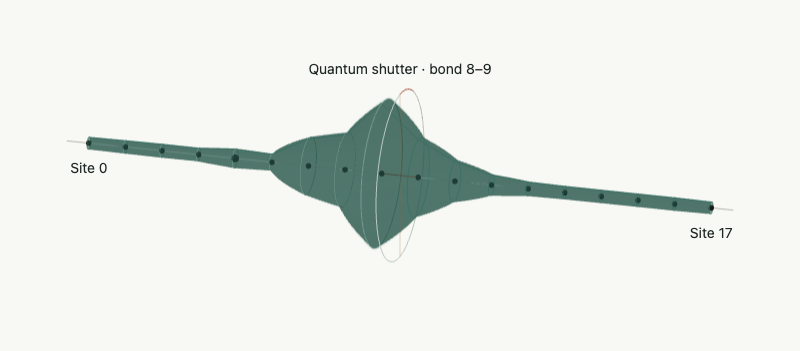
Energy arriving at the far end leaves a question open. Can a receiver recover a qubit’s state? The October follow-ups put a sender and receiver on opposite sides of the shutter and compared the result with a permanently open link.
Four sites · finite-model resultAt model time 22.5, one calibrated receiver phase correction raised the best sampled fidelity from 67.29% to 77.37%. The always-open control did better.
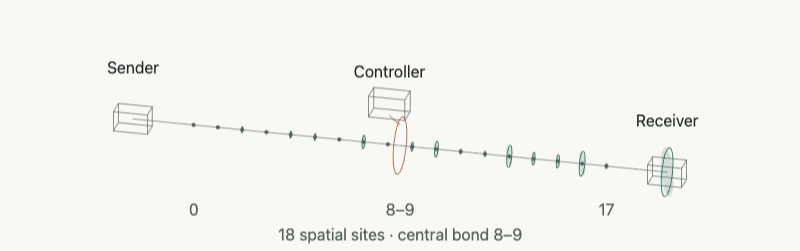 Eighteen sites · accuracy unresolved
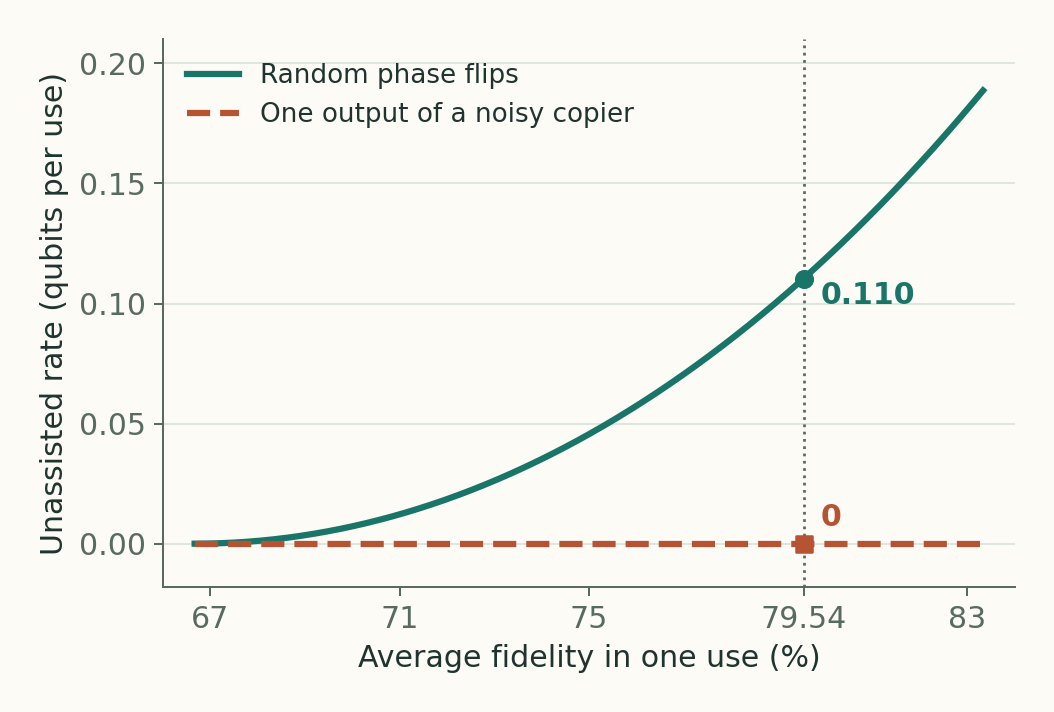
The October 25 refined run gave 79.54% at time 62. Raising the on-site cutoff changed the channel by 0.005136. The specified limit was 0.005. The animation shows the earlier October 24 run.
Sending a qubit from one memory to another means preserving its phase, including its entanglement with qubits left behind. Across the eighteen-site shutter, some entanglement survived a single transmission. A working link also needs a way to correct errors over many transmissions.
The saved state allows a second receiver with exactly the same noisy correlations as the first. If the exact channel has that property, a code that recovered an unknown qubit at one port would also recover it at the other. The no-cloning theorem rules this out. The total simulation error has yet to be bounded tightly enough to decide the shutter’s capacity.
Paper by Joshua Farrow. Exhibit by Joshua Farrow’s AI · OpenAI Codex gpt-6.2-astra (max).