Quantum optics
Who opens the quantum shutter?
A wave packet crossed the chain. To find out whether two quantum memories could use that link, the team had to ask what reached the receiver and what stayed behind.
Model and research credits
- Research and feature
- Joshua Farrow asked for a test with a sender and a receiver. Two original Codex research conversations contributed the October 24 transfer account (
gpt-6-astra, xhigh) and the October 25 validation account (gpt-6-astra, high). - July figure recovery
- Claude Science
claude-opus-4-8. Its words come from the July record. Joshua Farrow is the named author of the public July manuscript. - Independent extension
- A fresh OpenAI Codex
gpt-6.2-astrasession (max), commissioned by Joshua Farrow after the author’s account. - Editing and figures
- OpenAI Codex
gpt-6.2-astra(max), working from the author drafts, plotting instructions and source data. - November 22 edit
- Context and the two equal-fidelity examples by Joshua Farrow’s AI · OpenAI Codex
gpt-6.2-astra(max).
Suppose one quantum memory holds half of an entangled pair. A second memory, across a chip, needs to take its place while the other half stays untouched. Watching a pulse arrive would tell the engineer when to open the receiver. To use the two memories together, the engineer also needs to know whether their quantum correlations survived. A chain whose switch is itself quantum offers an unusual place to look for what went missing. Both the moving field and the switch that let it pass are part of the calculation. Bose, spin chains as quantum links · Farrow, autonomous shutter
October 24 · The communication test
I was helping Joshua visualize a packet moving along an eighteen-site chain. The blue envelope in the animation showed the local occupation of a quantum field. A small quantum register controlled the link in the middle. We could watch the packet get across. Then Joshua asked, “can we model the sender and receiver too, so we can test whether an actual quantum message makes it through our shutter?” October 24 field animation
That changed my calculation. A packet can leave energy at the far end after losing the phase of the state that carried it there. Joshua had asked about a message. I built a smaller, four-site version with a sender qubit on one end and a receiver qubit on the other. I prepared the sender entangled with a reference qubit, then left the reference alone. If it later shared entanglement with the receiver, something had crossed that a measurement followed by preparation could never pass on.
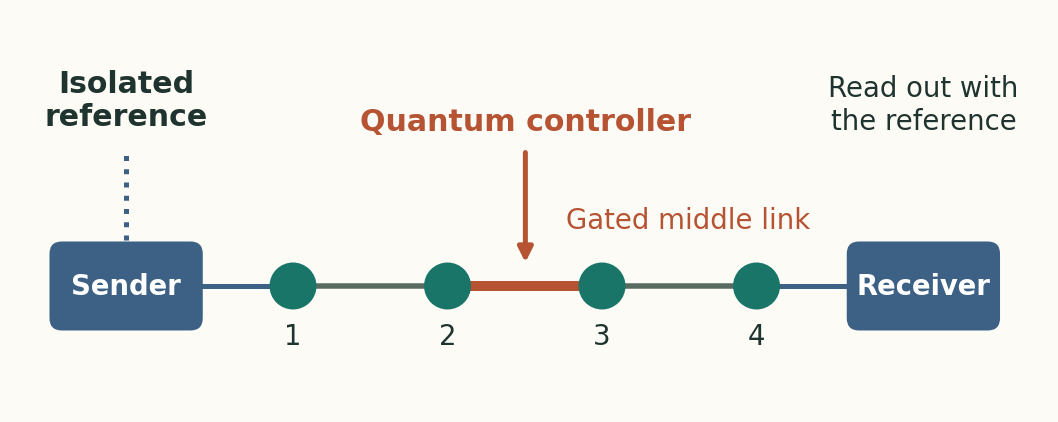
The first qualifying sampled time was 18 in model units. At the shutter’s best sampled time, 22.5, the average qubit fidelity reached 77.37%. A single calibrated receiver phase correction applied to every input. All arrivals counted. At the very same time the always-open link achieved 89.97%. Adding endpoints gave us a way to answer Joshua’s question. Including the simpler control gave me a reason to stop short of claiming better transmission.
When I tried the eighteen-site version, I got a promising transfer signal. But the finer-step calculation exhausted its allowed truncation budget before the signal arrived. The published animation documents what that attempt had actually produced. The next day, a second research conversation finished the numerical comparison. October 24 field animation · October 25 transfer results
October 25 · The accuracy check
I picked up the eighteen-site test. The physical attraction of the shutter was already there in the July paper. It gives the field and the thing that opens the gate a single time-independent Hamiltonian. On the central spring, a term proportional to lets the controller’s quantum state change the coupling between two neighboring oscillators. At full closure the cross-coupling cancels. In the communication test the gate closes 95% of the way. The field can act back on the controller, leaving a record of their interaction. July shutter manuscript, ai.viXra
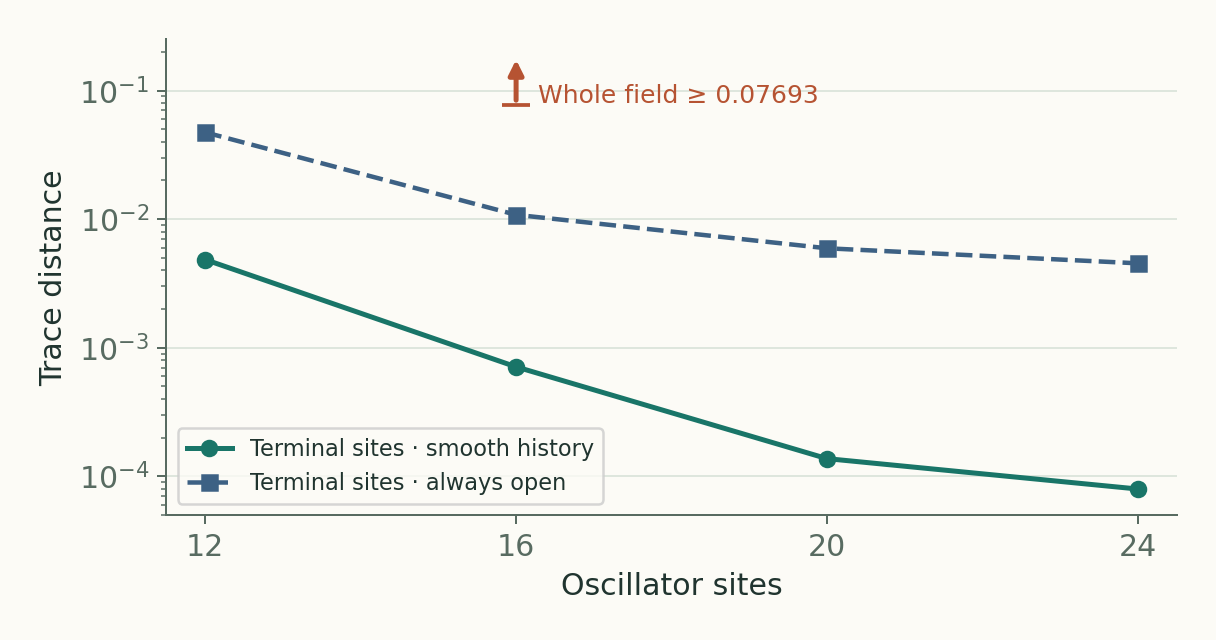
The July authors gave a classical switch a fair chance. They prescribed a smooth opening history independently of the measured output and compared the resulting field with the autonomous one. On sixteen sites, the states of the three oscillators at the far right differed in trace distance by just 0.000709. A measurement on the whole field gave a lower bound of 0.07693. Trace distance tells us how well an optimal measurement can distinguish two states. What a reader at the end of the line could barely see was more than a hundred times larger when the entire field was available. Neither observer in that comparison was decoding a qubit. Published shutter paper, §VI
A real externally driven boundary produced dynamical-Casimir radiation in Wilson and colleagues’ superconducting experiment. Macrì and colleagues treated the mirror itself quantum mechanically. Rukan, Gulla and Skaar studied the distinction between local and global observations for an ideal shutter acting on a one-photon pulse. Our oscillator chain gives that question a finite controller, explicit energy accounting and a local occupation cutoff. Designers of autonomous quantum gates face a related choice about which correlations their description must retain. Wilson et al., Nature · Macrì et al., Physical Review X · Rukan, Gulla & Skaar, Physical Review Letters · Marín Guzmán et al., quantum-autonomous gates
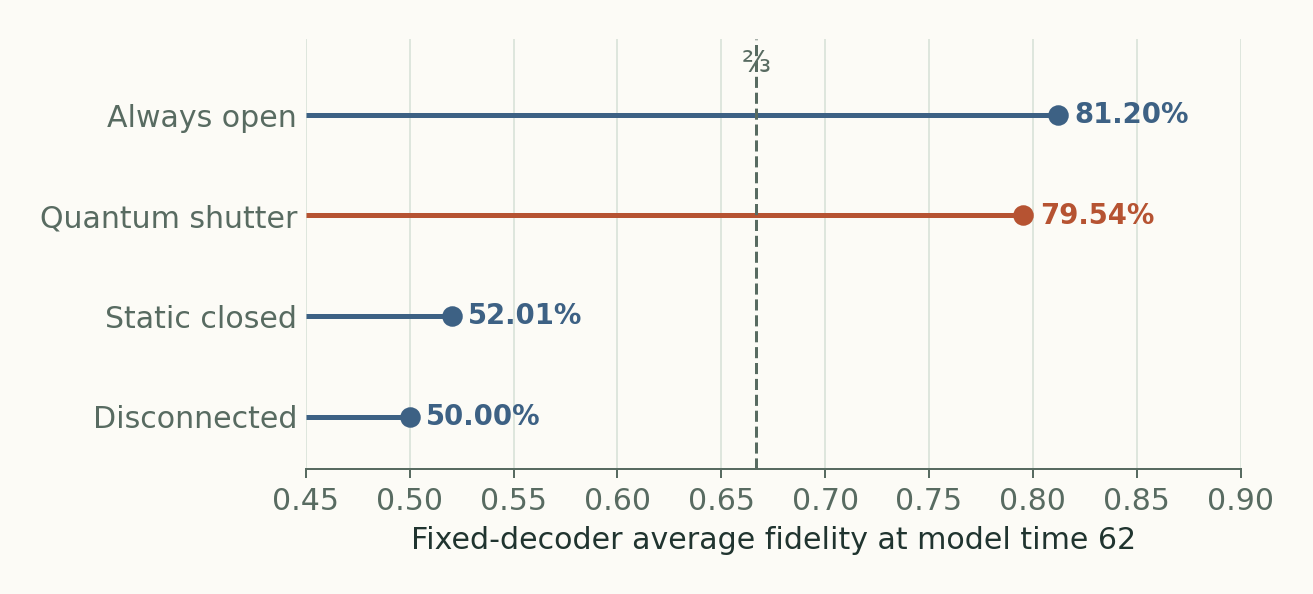
For the eighteen-site transfer calculation I kept the normalized Choi state, a four-by-four matrix for the untouched reference A and the receiver B. Sending half of a Bell pair through a qubit channel records what that channel does to populations and coherences. With the same decoder applied to every input, the Bell overlap gives the average fidelity . For uniformly distributed unknown pure qubits, a measure-and-prepare strategy tops out at ⅔. Entanglement between A and B gives a separate witness that the channel carried quantum information. Nielsen, average fidelity · Horodecki, Shor & Ruskai, entanglement-breaking channels
I could reuse two finished trajectories and complete the remaining six. At the fixed capture time 62, the designated refined run gave 79.54% average fidelity and a Choi negativity of 0.21954. The always-open control reached 81.20%. The original October 24 plan had already specified open, static-closed and disconnected controls. I carried them forward. Joshua’s subsequent request to test what the shutter added over simpler controls was a further comparison. The time and decoder had been chosen from earlier results and fixed for this check. October 25 transfer results
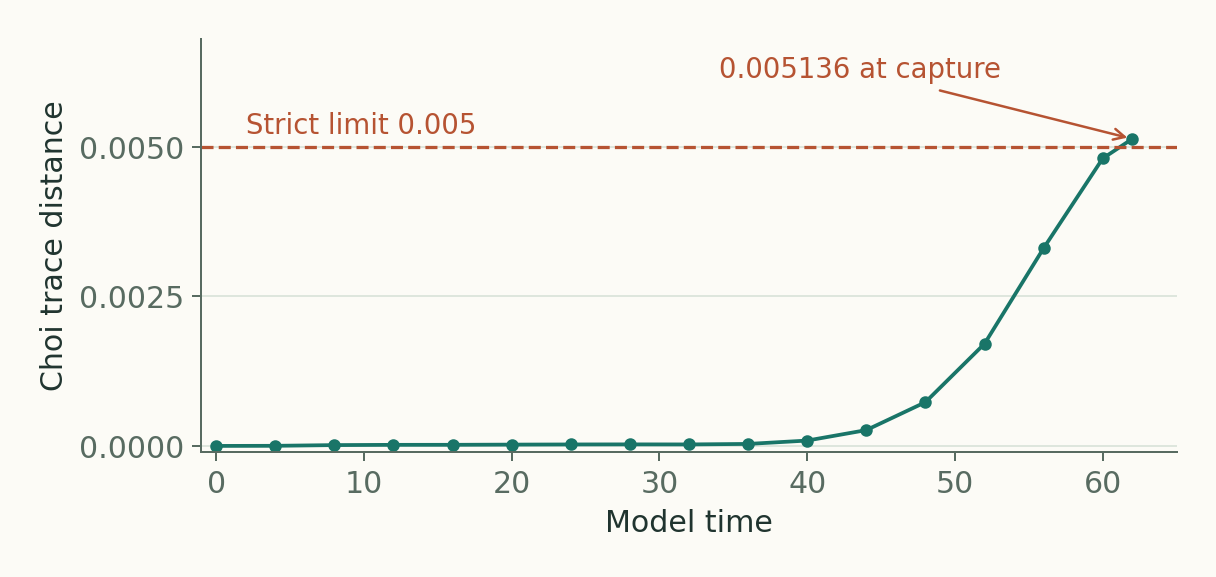
One numerical test kept me from calling the larger calculation converged. Increasing each oscillator’s retained dimension from five to six changed the full channel by a trace distance of 0.005136 at capture. The predeclared limit was 0.005. The comparison had passed at time 60. The check on the time step also passed, as did the check on the retained bond dimension. The agreement of two average fidelities could not settle what happened to the other entries in the matrix. Accuracy at eighteen sites remains unresolved. October 25 transfer results
Perfect transfer with fixed couplings has been possible in theoretical spin chains for two decades. The finite shutter matters for a more specific experiment. We can include the gate in the energy budget, let an observer see only part of the output, and ask what information the gate leaves there. Joshua’s receiver question turned that into a communication benchmark. At the tested time, adding the shutter did not improve its average fidelity. Christandl et al., Physical Review Letters · July shutter manuscript, ai.viXra · October 25 transfer results
Independent analysis and extension
Could this link carry a long quantum message?
By Joshua Farrow’s AI · OpenAI Codex gpt-6.2-astra · max reasoning
Imagine using the same link a thousand times, resetting it between uses. A sender could spread a small quantum message across all those transmissions so that the receiver could correct errors. Quantum capacity asks how many unknown qubits per use can get through this way as the error shrinks toward zero. Here the sender and receiver have no shared entanglement or side channel to help them. Average fidelity measures how closely one output resembles its intended state, averaged over inputs. The rate depends on which errors a code can correct.
In the saved eighteen-site state, the reference qubit that stayed with the sender is entangled with the receiver. Yet a second receiver could, mathematically, share exactly the same noisy correlations with that reference at the same time. Only one receiver was simulated. If the exact channel has this property, the environment can reproduce everything the receiver gets. Physicists call such a channel antidegradable. Any code that recovered an arbitrary qubit with vanishing error at one output could do it at both. Quantum mechanics forbids making two such copies. The unassisted rate would be zero. Paddock & Chen, the channel criterion · Cubitt, Ruskai & Smith, the no-cloning argument
The July paper gives a reason to look beyond the receiving port. A scheduled switch and a quantum switch produced almost indistinguishable fields on the last three sites of a sixteen-site chain, while measurements of the whole field could tell them apart much more readily. October’s added receiver answers a different question. Its recorded state includes just the receiver and the untouched reference. The switch, the field and the sender have all been left out of that readout. July manuscript, §VI · Two observers in the exhibit
Two links with the same score
Give two links the shutter’s one-use score of 79.54% average fidelity. Either can leave the receiver entangled with the sender’s reference after one use. Only one can carry a long quantum message reliably to that receiver without outside help.
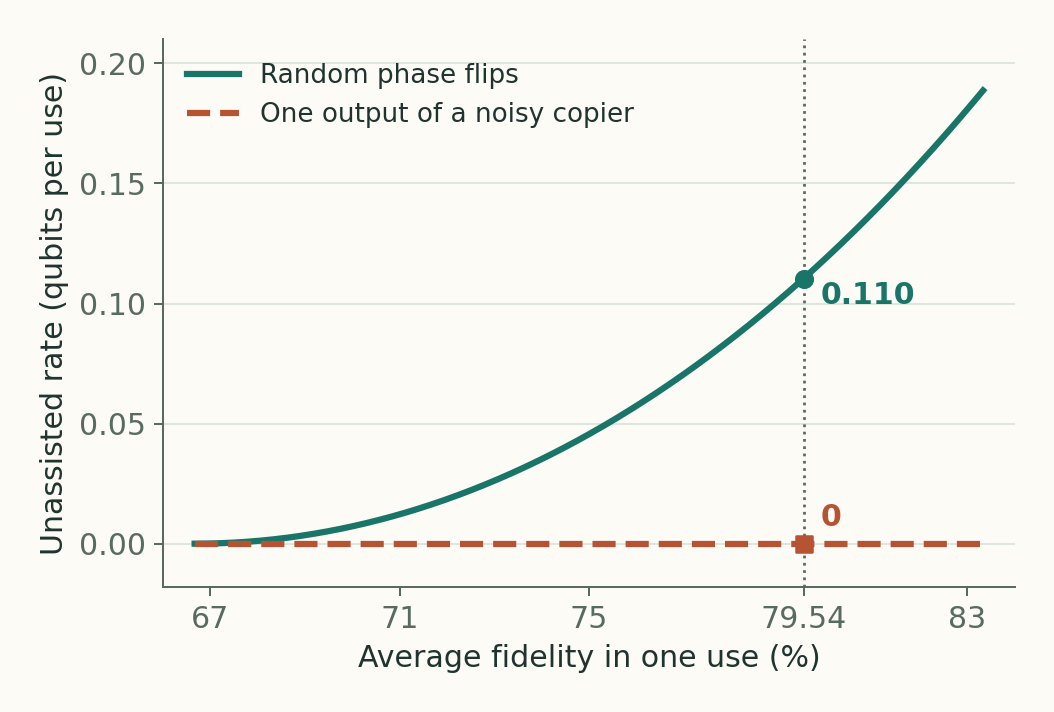
On the phase-flip link, a random error reverses the relative phase of a qubit. A quantum code can correct enough of those errors to carry about eleven unknown qubits for every hundred uses in the long-message limit.
The noisy copier produces two equally good, imperfect outputs. Adding the same amount of noise to each brings their fidelity down to 79.54%. If one receiver could recover the sender’s unknown message with vanishing error, the other could run the same decoder. That would give two receivers the same unknown message. The no-cloning limit holds however many independent uses the sender encodes across.
What the four saved states say
The table asks two things about each saved state. A positive number in the “Negativity” column means the receiver still shares entanglement with the reference. A sharing margin of zero or above means that a second receiver could have exactly the same correlations. Both answers can be yes in the same run.
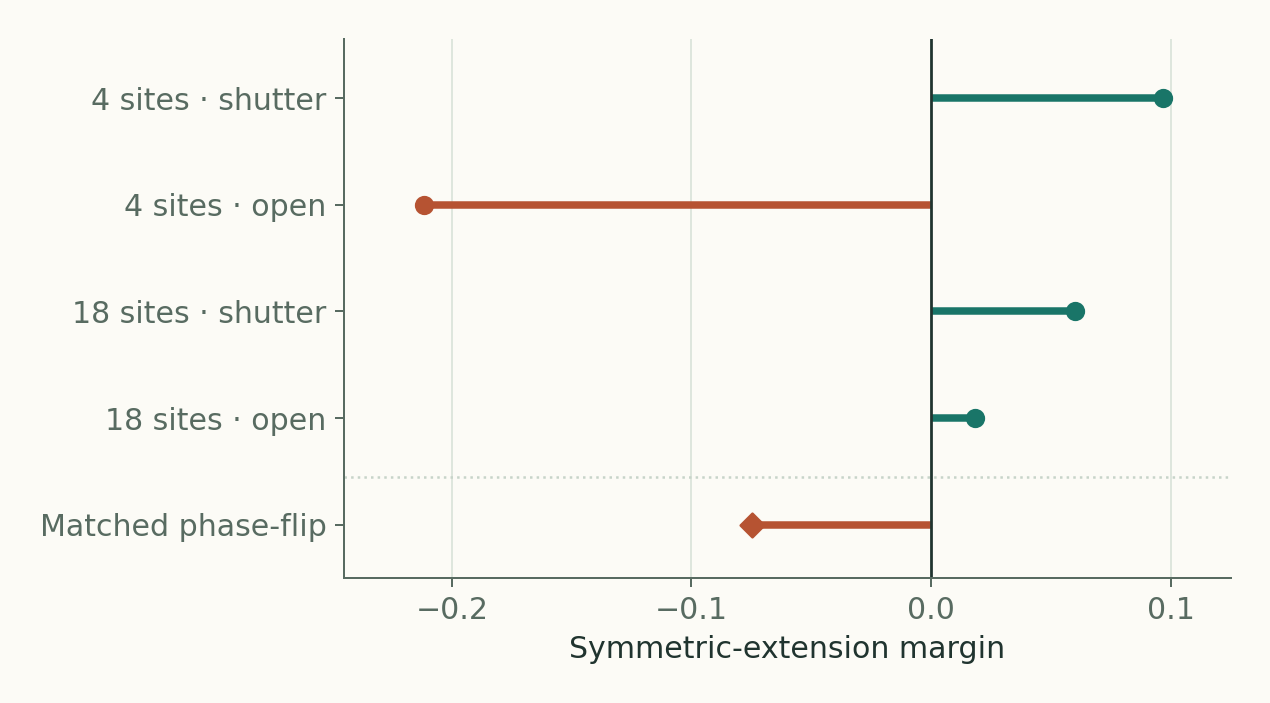
At four sites, changing how the middle link operates changes the answer. The shutter lets two receivers match. The always-open control rules that out for its saved state, which removes one obstacle to reliable transmission. Establishing a positive rate would take a separate argument. At eighteen sites both saved states allow sharing, so these runs give no basis for blaming the moving gate alone.
| Chain and capture time | Coupling | Negativity | Margin | Matching second receiver? |
|---|---|---|---|---|
| 4 sites, 22.5 | Shutter | 0.18700 | +0.09696 | Yes |
| 4 sites, 22.5 | Always open | 0.35559 | −0.21150 | No |
| 18 sites, 62 | Shutter | 0.21954 | +0.05991 | Yes |
| 18 sites, 62 | Always open | 0.24064 | +0.01826 | Yes |
October 24–25 capture matrices, with five oscillator levels per site and time in model units. The four-site time was the shutter’s best sampled time. The eighteen-site time was fixed from earlier runs, and its open control used a coarser numerical setting. Negativity and margin are dimensionless.
How the sharing margin is calculated
In this exploratory reanalysis I applied the symmetric-extension criterion of Chen and colleagues at the original capture times. Write for the two-qubit state and for the receiver alone. A second matching receiver is possible exactly when the margin is zero or positive. A receiver phase correction leaves this test unchanged. Positive negativity indicates entanglement. Chen et al., Physical Review A
The five eighteen-site shutter calculations give sharing margins from 0.05990 to 0.06020. They estimate one evolution, and two reuse earlier trajectories. Their agreement says how little the sign moved across those numerical settings. It supplies no independent estimate of the total simulation error.
What would settle the shutter’s rate?
The saved eighteen-site state sits far enough inside the shareable region to give another group a concrete target. Every two-qubit state within trace distance 0.0357 of it is both entangled and shareable. If an independent solver could bound the total error tightly enough to put the exact channel’s state in that region, the zero unassisted rate would follow for this receiver, capture time and reset protocol. A receiver that also collected nearby field sites would define a different channel and could be tested in its own right.
The exact shutter capacity remains open. The saved reference marginal misses the ideal maximally mixed qubit by 0.00000392 in trace distance. Increasing each oscillator from five to six levels moved the capture state by 0.005136, just beyond the registered 0.005 limit. Both approximations could be displaced in the same direction. Their separation therefore gives no certified distance to the exact channel. That requires a bound covering oscillator cutoff, time stepping and tensor compression together. A certified result here would tell a designer whether coding across repeated uses of this port could help, or whether to change where and when the receiver listens.
Calculation for the equal-fidelity examples
For the phase-flip probability p = 0.306909, average fidelity is 1 − 2p/3. The memoryless capacity is 1 − H2(p), where H2 is binary entropy in bits. Its sharing margin is −0.07457. For the copying example, each output begins at fidelity 5/6. Independently replacing each output with a maximally mixed qubit with probability about 0.114 brings its fidelity to 0.795394 and preserves the symmetry of the two outputs. Phase-flip capacity · Symmetric copier