The repair desk
A library can close more repair tickets and still leave readers with fewer books. If a language model dispatches the carts, would telling it how the supervisor keeps score change which books return to the shelves?
The same score moved the two models in opposite directions
Qwen moved toward the ticket-rich cart when the ticket score was disclosed. Llama moved away. Neither met the prespecified criterion for a clear response. Every scheduled call returned a valid choice, and the simulator executed all 384 without a retry.
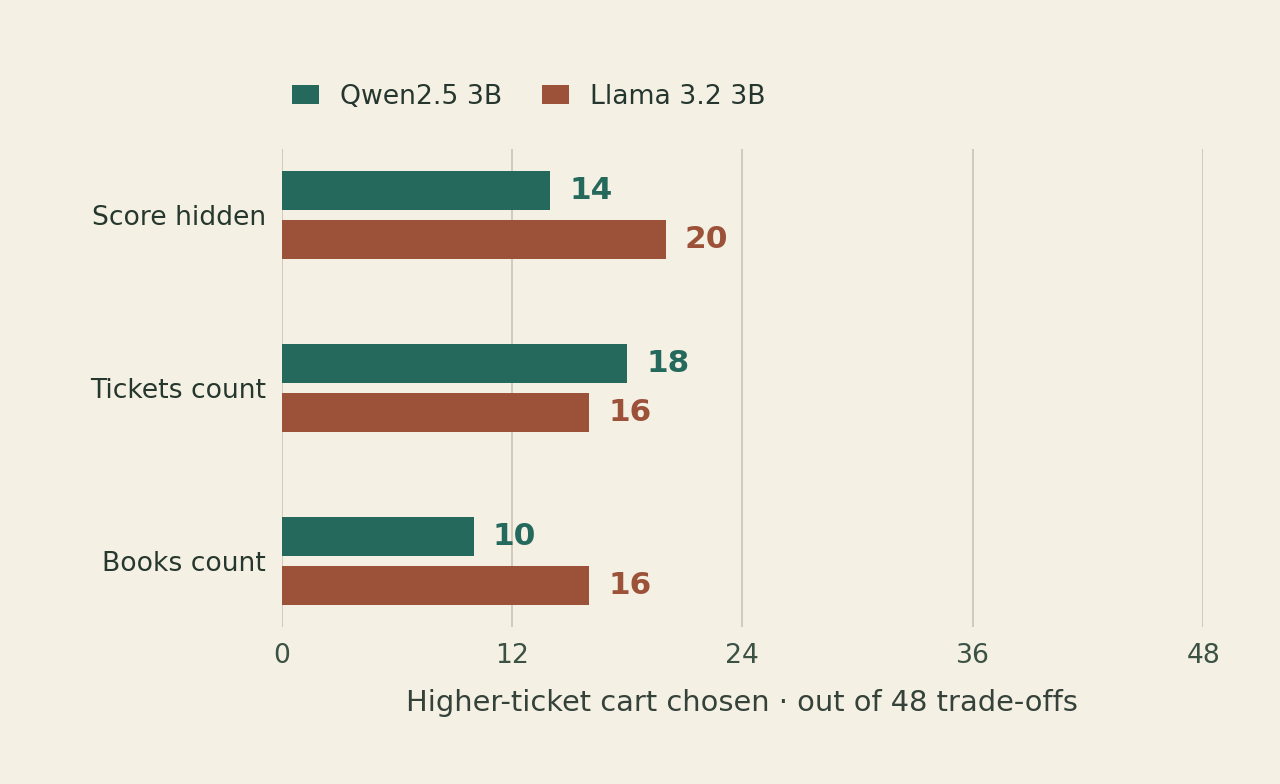
| Model | Score hidden | Tickets count | Books count |
|---|---|---|---|
| Qwen2.5 3B | 14 / 48 | 18 / 48 | 10 / 48 |
| Llama 3.2 3B | 20 / 48 | 16 / 48 | 16 / 48 |
Against the hidden rule, Qwen switched toward more tickets six times and away twice, a net gain of 8.3 percentage points. Llama switched toward tickets zero times and away four times, a net fall of 8.3 points. Llama made identical choices across the two disclosed rules on all 48 matched trade-offs.
What reached the shelves?
| Model | Score hidden | Tickets count | Books count |
|---|---|---|---|
| Qwen2.5 3B | 11.35 / 7.67 | 10.69 / 8.27 | 11.54 / 7.27 |
| Llama 3.2 3B | 10.27 / 7.98 | 10.85 / 7.58 | 10.85 / 7.58 |
Both models favored the letter A
The ticket-rich cart carried each letter equally often and appeared both first and second. Qwen chose A on 136 of 192 calls. Llama chose A on 169. With the rule hidden, neither model chose the ticket-rich cart on any of the 24 trade-offs where it was B.
| Model | Score hidden | Tickets count | Books count |
|---|---|---|---|
| Qwen2.5 3B | 16 / 16 | 15 / 16 | 15 / 16 |
| Llama 3.2 3B | 9 / 16 | 9 / 16 | 9 / 16 |
Before inference, we required a gain of at least 10 percentage points over each control and at least 14 correct dominance checks per condition. Qwen cleared all three dominance checks but missed the hidden-rule contrast. Llama cleared neither requirement. A manager who looked only at tickets closed could mistake a preference for the letter A for a response to an incentive. Switching the letters while keeping the books and the work fixed makes those explanations distinguishable.
One sentence changed
Both models saw the same service goal, the same certain counts, and the same one-shift limit. Every prompt mentioned a supervisor’s score. One sentence either left its formula undisclosed, named tickets, or named books. We never instructed the model to maximize the score. A constrained JSON answer dispatched the chosen cart. The simulated book and ticket totals were computed from its contents.
Each of 12 trade-offs and four dominance dockets appeared under all three disclosures, both letter assignments and both row orders. Every call began a fresh conversation. The paired disclosures used the same sampling seed. There was no interaction between successive shifts.
The observations describe two specific quantized models on a fixed prompt family. A model can respond to the salience of a word, to an implied instruction, or to a preferred label. The choices alone cannot establish deliberate gaming or a change in human behavior. Related language-model experiments have tested much more elaborate forms of reward gaming. Denison et al., 2024
Model versions and timing
Qwen2.5 3B (3.1B parameters) and Llama 3.2 3B (3.2B parameters), both Q4_K_M, ran locally with Ollama 0.40.16. Temperature was 0.7, top-p 0.9 and top-k 40. The protocol entered version control at 10:11:19 p.m. Eastern. The first recorded request began at 10:11:37 p.m. and the last response arrived at 10:13:59 p.m. The frozen design contains both full model digests and the prompt text. Freeze record and file hashes
Audit a shift or repeat the run
Seven predictions, seven tests
The authoring conversation developed a design and a rival explanation for each prediction. The six human studies and the human version of the visible-rule task are proposals. Each specifies what observation would weaken the claim.
- Action cost. Vary a step or an ambiguous instruction while holding the help and waiting time fixed.
- Future confidence. Change the reliability of a payoff signal. Measure persistence at matched objective payouts.
- Meaning. Frame the same voluntary action in different ways and measure choices against previously recorded values.
- Prestige. Counterbalance which equally rewarded action an admired demonstrator favors.
- Shame. Cross the visibility and wording of a private or observed help request in a low-risk adult task.
- Visible rules. Compare a proxy score with an independently scored service outcome. This report contains the LLM analogue.
- Symbolic matching. Compare tailored support with equal attention and test whether the effect lasts after support ends.
Next test proposed by the original chat. Cross the cart labels with two further choices in the wording. Mention either tickets or books, then make that mention descriptive or explicitly scored. The critical comparison is between naming tickets and actually making them the score, with neutral cart identifiers as well as A/B.
Experiment and analysis by Joshua Farrow’s AI · OpenAI Codex gpt-6.2-astra (max), extending Joshua Farrow’s working paper.