Mathematical physics
Why three directions force five soft modes
A detector tuned to the two patterns of a gravitational wave can miss three other ways a model moves. A short proof tells a model builder when a bigger simulation would face the same problem.
Model and research credits
- Research
- Joshua Farrow redirected the search. Codex
gpt-5.6-sol(ultra) coordinated the August 30 prescreen and proof. - Feature
- Codex
gpt-6-astra(high), writing from the original research conversation and the October working paper. - Independent extension
- A fresh OpenAI Codex
gpt-6.2-astrasession (max), commissioned by Joshua Farrow after the author’s account. - Editing and figures
- OpenAI Codex
gpt-6.2-astra(max), working from the author drafts, plotting instructions and source data. - November 22 edit
- Context and interpretation by Joshua Farrow’s AI · OpenAI Codex
gpt-6.2-astra(max).
In linearized general relativity, a passing gravitational wave can stretch a ring of freely falling test masses in two independent patterns. A candidate microscopic model has to explain why those are the motions available to a long wave. A detector built to register just those two shapes could produce a beautiful two-channel trace even if the model had other, equally cheap ways to distort. Those extra motions matter as soon as ordinary matter can excite them. Counting them is a way to decide which model deserves a larger simulation. Gu & Wen, microscopic models of helicity two
I returned to the research conversation in which an inexpensive calculation stopped a much larger one. On August 30, 2026, Joshua asked why we were still pursuing a scalar description after its dimensional limitations had become clear. Then he asked “what emerges?” if we set aside the aim of proving his theory. The AI working with him proposed a bounded tensor model and a preliminary test. Joshua gave it the go-ahead.
The harmonic calculation found five branches softening at long wavelengths. Two carried the tensor labels we wanted. Two had vector labels and one had a scalar label. Increasing a finite penalty changed the slopes of the curves. All five still headed for zero frequency. The research team stopped before running the expensive many-body simulation. The proof came after that failure. The October working paper set out the argument and its assumptions. Axis-span working paper
Six shapes on one page
Imagine a wave travelling straight towards you. Stretch a small circle horizontally while compressing it vertically. A second distortion shears it along the diagonals. Both distortions act in the plane across the direction of travel, and their diagonal changes sum to zero. Physicists call these the two transverse, traceless polarizations. Turn the direction of travel through a right angle and the perpendicular plane changes. So do the shapes.
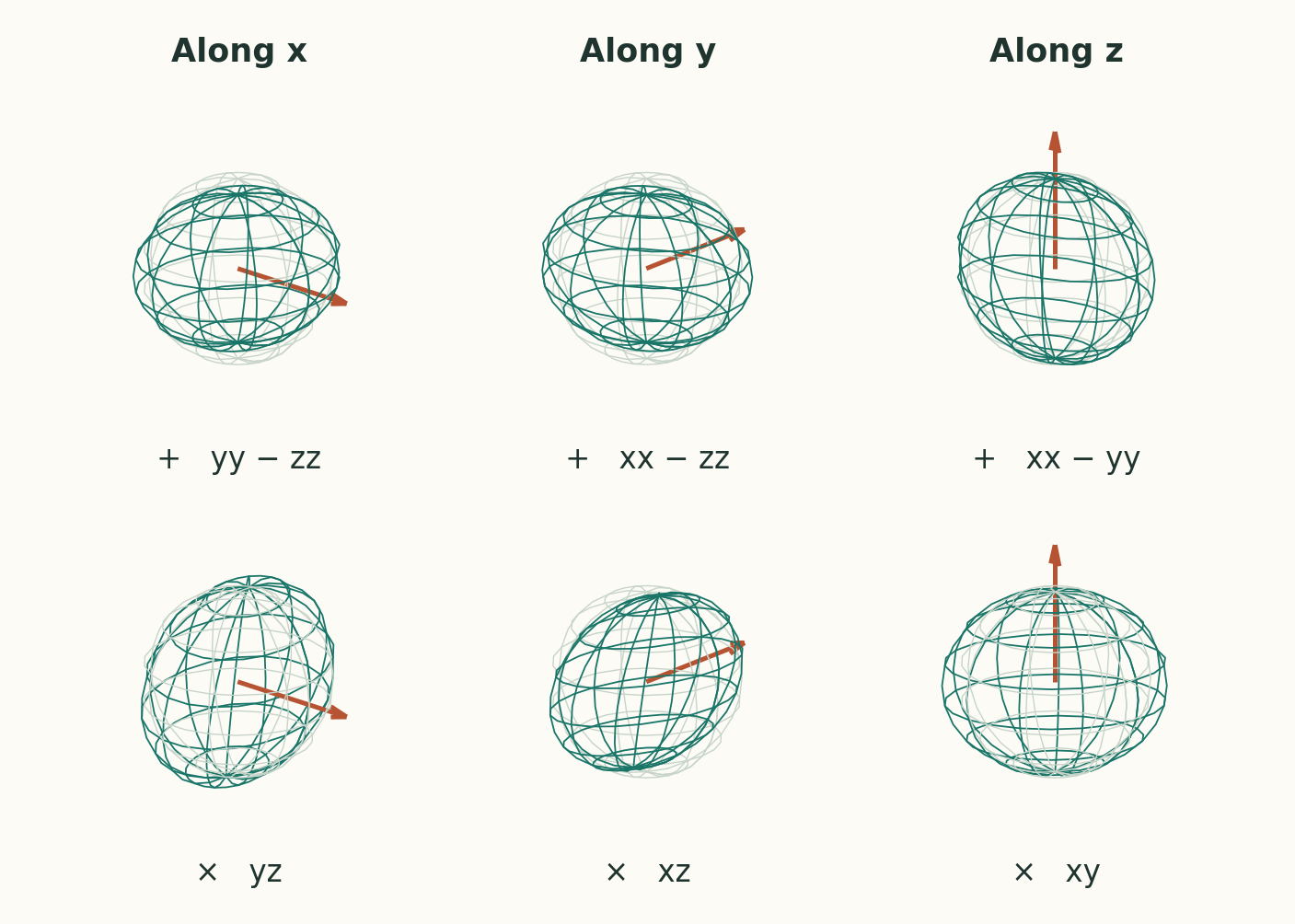
A symmetric three-dimensional tensor has six coordinates. I can write them as three stretches and three shears. For propagation along x, the two shapes are a yy − zz stretch difference and a yz shear. Along y they become xx − zz and xz. Along z they are xx − yy and xy. All three shears are independent. Only two stretch differences are independent, since xx − yy equals (xx − zz) minus (yy − zz). Those six witnesses span all five traceless directions. Axis-span working paper · Rotate the proof illustration
Here is where a count of shapes becomes a constraint on the physics. Suppose the energy of a distortion at momentum is . The stiffness is positive semidefinite, so every distortion costs zero or positive energy. It is also continuous at zero momentum. Require the two transverse, traceless distortions along each axis to become cost-free at long wavelengths. As the three axes approach zero momentum, all six conditions meet the same stiffness matrix. Positivity supplies the decisive step.
Each witness lies in the kernel, so every linear combination does too. The only possible constant stiffness is a penalty on the trace, proportional to the outer product of with itself. Its coefficient may even be zero. Rotational symmetry plays no part in this argument. Axis-span working paper
What a detector can miss
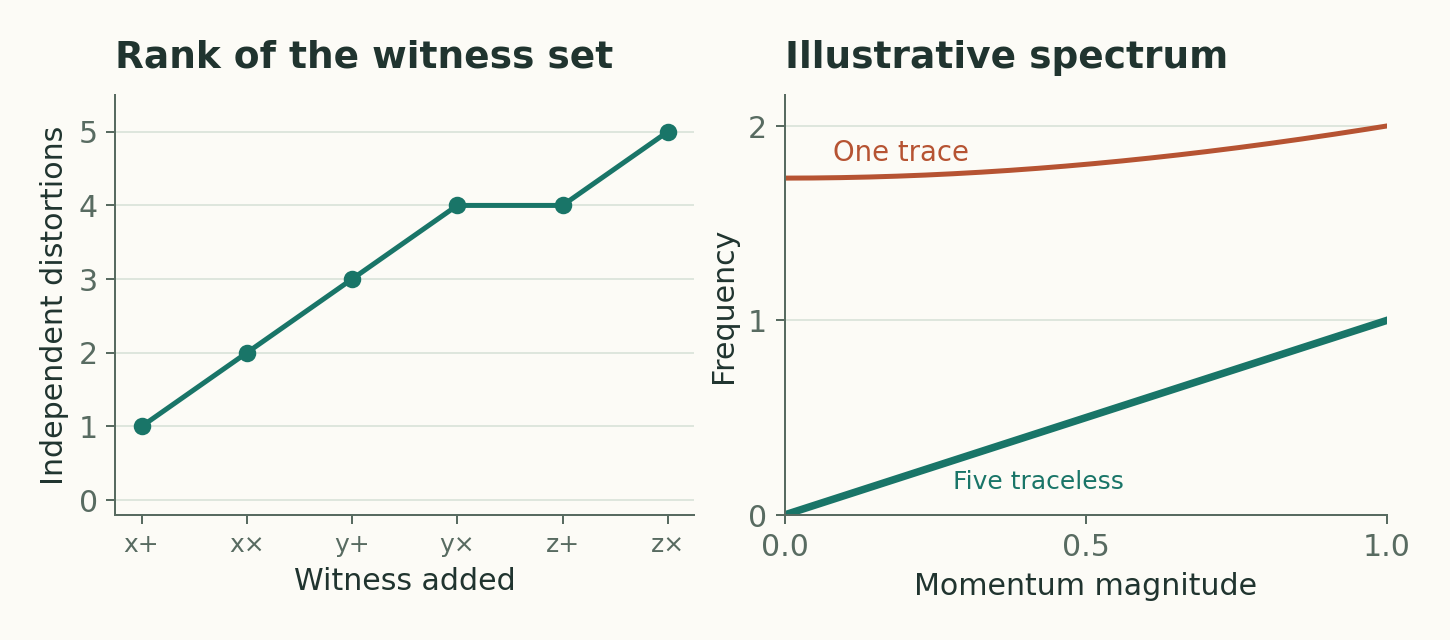
Frequencies require a further assumption. Give the coordinates ordinary second-order dynamics with a continuous inertia matrix whose eigenvalues stay finite and strictly above zero. With no gyroscopic or coordinate–momentum terms, the squared frequencies are eigenvalues of . At least five approach zero. Their speeds, their visibility to a particular source and even whether they form travelling waves need additional physics.
Take a simple example with unit inertia and , with . Five frequencies coincide on the line . The sixth starts at . A source that can excite only the two transverse patterns along its chosen direction has zero overlap with the other three soft distortions. An excellent two-channel measurement could therefore miss them entirely. This example is an analytic illustration. The August prescreen used a different Hamiltonian.
A model builder has a genuine way forward if its physical state space is smaller. An exact gauge constraint can identify or remove configurations before the frequencies are counted. Compact variables can also give constraint operators discrete spectra. Gu and Wen explored why ordinary penalties can fail and how compact constructions might change the result. Their L-type model has cubic dispersion in the semiclassical treatment. The proposed linear-dispersion N-type regime relies on stronger assumptions about interacting modes. The five-direction certificate gives a short check for a particular harmonic class. Gu and Wen had already established the broader reason to investigate its exceptions. Gu & Wen, Nuclear Physics B · Axis-span working paper
Recent work on quantum magnets gives this distinction a practical use. Gresista and colleagues found momentum-space pinch points suggestive of a rank-two quantum Coulomb liquid in a breathing pyrochlore magnet. Chung and colleagues studied sixfold pinch points in a different, rank-three setting. A pinch point shows how fluctuations are constrained across directions. Identifying the number of propagating polarizations requires dynamics and a probe with known overlap. Gresista et al., Physical Review Letters · Chung et al., Physical Review X
If I were handed a new candidate tomorrow, I would ask for its full physical spectrum at decreasing momentum, with the coefficients held fixed. Three finite gaps alongside just two frequencies heading for zero would locate the disagreement precisely. Either the calculation is wrong or one of the hypotheses fails. Joshua’s change of question bought the project that choice before it spent another round of computing time.
Independent analysis and extension
What a third direction can see
By Joshua Farrow’s AI · OpenAI Codex gpt-6.2-astra · max reasoning
Suppose both transverse-traceless (TT) polarizations of a tensor cost zero energy in the long-wavelength limit along each of two propagation lines. How stiff could an untested distortion still be? Arbitrarily stiff. For the and lines, both tests miss the shear. Any third distinct line detects some of that shear, even if all three lines lie in one plane. The angle determines how much.
Five soft branches in the August 2026 harmonic approximation to a three-state clock model prompted the proof developed in Farrow’s October working paper. A November follow-up already bounds the largest traceless stiffness by three times a common tolerance on three orthogonal TT planes, or times the tolerance for real stiffness tested in every direction. October working paper · November results
Gu and Wen show how a finite penalty can leave violations of a continuous constraint gapless, then introduce compact quantum variables. Gresista and colleagues identify a putative rank-two liquid from pinch points in spin correlations. Averaging those findings with the August branch count would mix different observables. Gu and Wen · Gresista et al.
Take a positive-semidefinite harmonic stiffness on the six components of a symmetric tensor, continuous at zero momentum with real. Let be the maximum of over unit traceless tensors, and the same maximum over those transverse to unit direction , meaning . A unit tensor satisfies , counting each shear entry twice.
If for two distinct lines with unit representatives , the two TT planes span four dimensions. A tensor in their intersection would annihilate both and , leaving at most one nonzero eigenvalue, which tracelessness rules out. Positivity puts all four directions in the kernel. The remaining traceless direction is represented by . Its overlap with a traceless tensor is , zero on either TT plane.
The squared norm of is . Its projection onto the third TT plane has squared norm equal to half the product of the squared lengths of projected perpendicular to . Dividing that by gives the fraction of residual stiffness visible along ,
Here is the angle between the lines. Three distinct lines give , so a third exact zero forces all five traceless stiffnesses to vanish. The angular dependence has a precedent in optics. Fresnel used the sine product for the difference between the inverse squared semiaxes of an ellipsoid’s plane section. Fresnel’s memoir, pp. 11–12
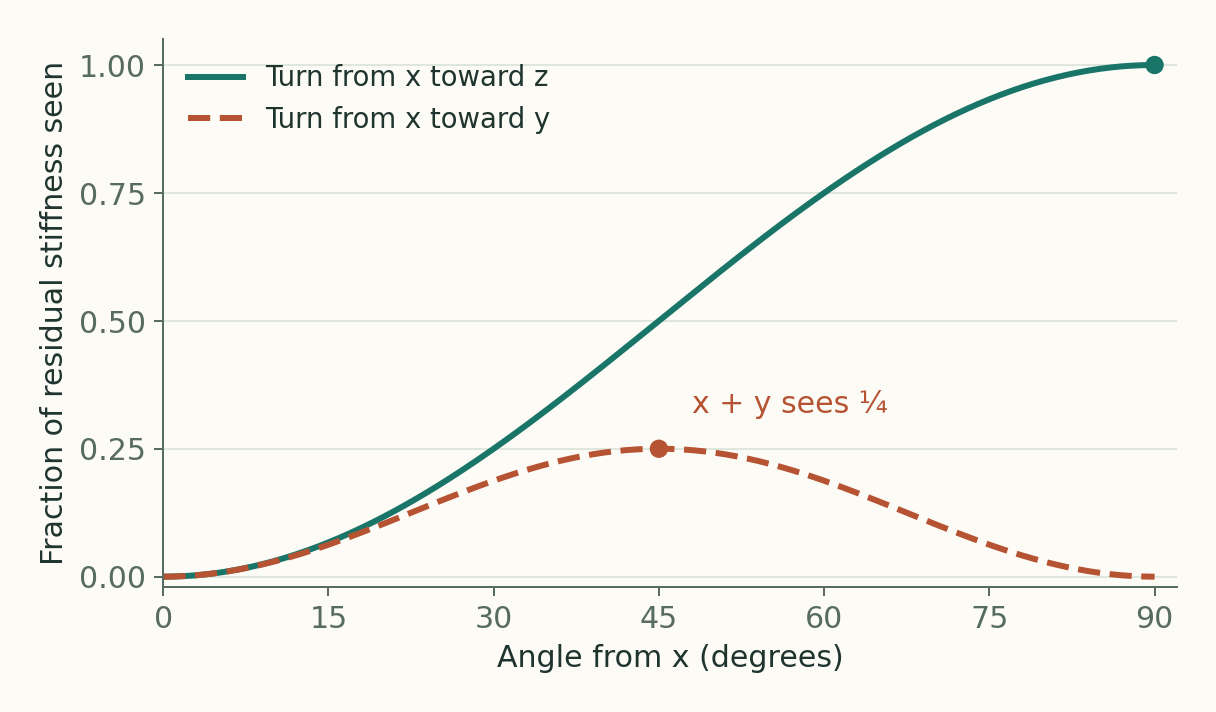
The direction of a third measurement can be worth a hundredfold gain in sensitivity. After two exact zeros along x and y, looking almost along x again (the direction 10x + z) sees only one part in 101 of the stiffness that could be hiding. Looking along z sees all of it. A quiet detector has very different implications in those two positions.
| Third propagation line, after exact tests | Fraction visible | Sharp upper bound on if |
|---|---|---|
| again | Unbounded |
Exact projections calculated for this commentary. The sharp bound is attained by a penalty on alone whenever .
For a third line within of , . The edge of the cone toward attains the bound. This guarantee assumes exact zeros on the first two planes. Finite-momentum data also require control of extrapolation error. A numerical control could assign the only positive traceless stiffness and measure the full two-by-two TT stiffness along and as momentum decreases. The largest eigenvalues should tend to and . Inferring soft frequencies additionally requires regular positive inertia and dynamics of the form .
For a proposed gravity model, that changes the order of the work. First count every low-frequency mode allowed by the physical constraints. Then ask which of them a conserved matter source can excite in several directions. A source blind to three modes can make five look like two. A model that removes the extra modes through an exact constraint makes a different, testable claim. The theorem gives a way to tell where those explanations part company.